Hunt for history
What better way to spend a rainy day than visiting a cosy museum and learn more about the heritage of the area?
Here are five choices for a day-out:
- Amberley Museum – Located in the heart of the National Park, this museum gives visitors a chance to connect with the South’s working past and see remnants of its industrial heritage. Explore the history of communications and have a go at printing in their working print shop, the only one of its kind in the South of England.
- Bignor Roman Villa – Enjoy the stunning remains of a Roman home with world-class mosaic floors in a spectacular Downland setting. Learn why the Roman owners chose to develop such a magnificent settlement at Bignor in the 3rd Century AD and how they acquired wealth from its location.
- Gilbert White’s House – Gilbert White was a leading British naturalist of the 18th Century. Writing nearly a century before Charles Darwin published On the Origin of Species, Gilbert White observed and chronicled the natural world from his Selborne home in Hampshire. Today, Gilbert White’s House and the Oates Collection tells Gilbert’s story and his groundbreaking work in uncovering some of nature’s secrets right here in the South Downs.
- Petersfield Museum and Art Gallery – This fantastic museum, which benefited from a transformative £4m redevelopment a few years ago, is a rare example of a restored Victorian Justice Heritage site. Its extensive collections cover the archaeology and social history of the Petersfield area, together with a large photography collection and fashion and textiles collection. The Flora Twort Gallery is a dedicated art gallery with an ambitious programme of fine art and contemporary craft exhibitions and an inclusive public programme. It is also home to the Tim Wilton-Steer Collection of works by and about the poet and nature writer Edward Thomas, housed in the Edward Thomas Centre.
- Weald and Downland Living Museum – Discover what life would have been like for people in the South East of England up to 950 years ago at the Weald & Downland Living Museum. Over 50 historic buildings, rescued from various sites across the South East, provide the setting for an interactive way to discover England’s rural history.
Stargazing
After long summer days, the beauty of the South Downs night sky really comes alive in the autumn. October is a particularly good month for stargazing and Saturn will reach the pinnacle of its visibility. If you have a telescope, it’s a great opportunity to see the rings!
During the autumn, our nearest galactic neighbour, the Andromeda Galaxy, will be visible high in the southern sky and Hercules and Perseus are also great targets to look for.
Come November, ‘the Seven Sisters’ – not the South Downs version but the celestial version – will come into full view. The Pleiades is the most easily recognisable star clusters in the night sky. The brightest stars in the Pleiades asterism (pattern of stars) glow a luminous blue, and are bright enough to be seen with the naked eye!
Wrap up warm, take a hot flask, and enjoy connecting with nature on its grandest scale! Our Dark Sky Discovery sites are great places to start your stargazing adventures. Check out the Dark Skies Hub to learn more about stargazing in the South Downs.
Wherever you go this autumn in the National Park, make some great memories! Remember to care for this amazing landscape by putting all litter in bins or take home if there are no bins, bag and bin dog poo, and bring a picnic rather than a barbecue.
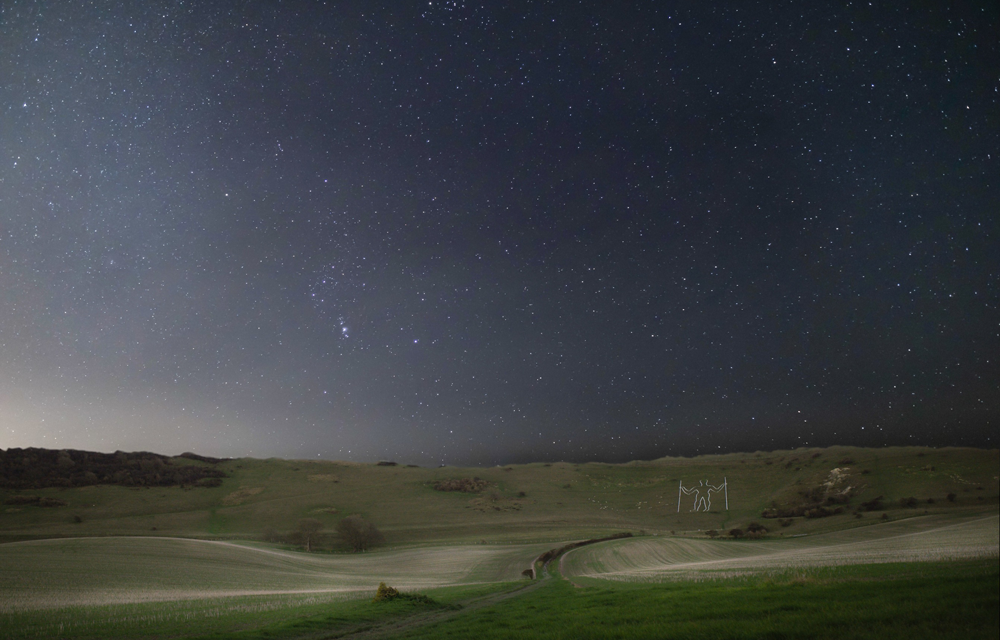
Image: The Long Man of Wilmington by Verity Stannard