A beautiful medieval route with an intriguing history has been given a new lease of life in the South Downs National Park.
There were cheers as the local community gathered to celebrate the improvements to the ancient West Burton to Bury Coffin Trail, in West Sussex.
For almost 1,000 years, before motorised transport, the deceased were carried by hand or on a horse-drawn cart along the path from West Burton to Saint John the Evangelist Church in Bury. Historically, West Burton did not have its own consecrated burial ground or church and, under ecclesiastical law, residents were required to be buried in the graveyard of their “mother church” – in this case Saint John’s in Bury.
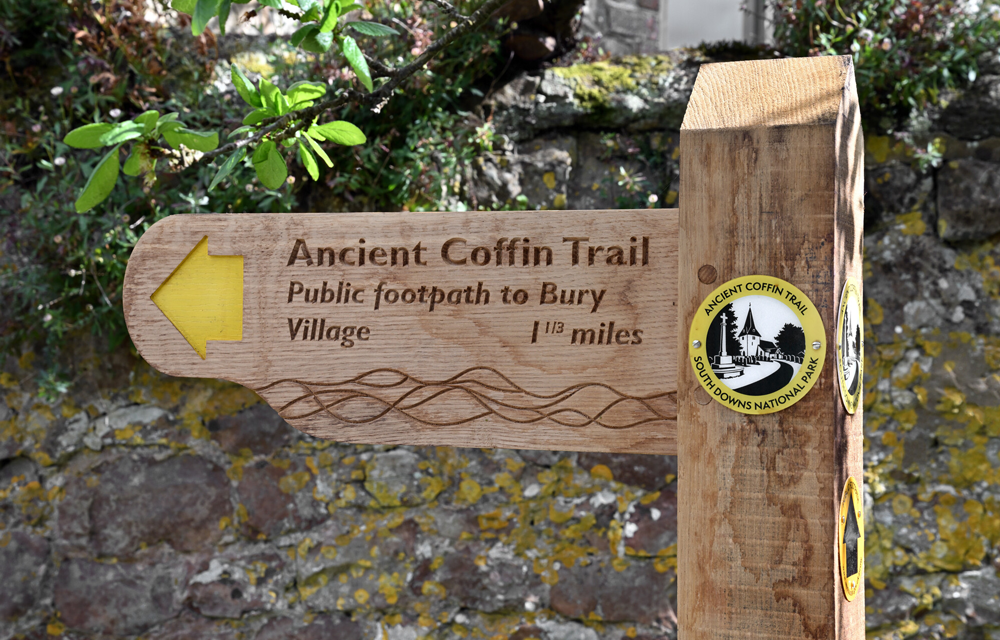
A much-needed makeover of the path has been completed by Bury Parish Council, with the support of the National Park Authority. Accessibility has been improved with the replacement of stiles with kissing gates, as well as new fingerposts and waymarks to help tell the story of the route.
The 1.3-mile route runs through the quintessential chalk downland of the South Downs and offers glimpses of streams, woodland, hidden vales, historic buildings and incredible views.
The Coffin Trail can be easily accessed via the South Downs Way, the popular 100-mile National Trail that weaves through the heart of the National Park from Winchester to Eastbourne.
Richard Champness, Chair of Bury Parish Council, said: “We really appreciate the support of the South Downs National Park Authority, and indeed West Sussex County Council, in helping us improve and put the wonderful historic walks in our parish ‘on the map’, as well as enhancing the health and well-being opportunities for our community.”
Ben Bessant, National Trails and Countryside Access Officer for the National Park, said: “It’s been fantastic to work with the local community on this makeover.
“The improvements have made the route far more accessible to more people, and I hope many people from both the local community and further afield, enjoy this really scenic walk.
“Heritage and local stories are a big part of the National Park Authority’s work, so I’m pleased that people will be able to find out more about this ancient route as they enjoy the fantastic views.”