Stardust jellyfish and dazzling valley shot win National Park’s cosmic competition
A galactic ‘jellyfish’ formed from a massive star that exploded 35,000 years ago and a stunning shot of the Milky Way over a South Downs valley are among the winners of this year’s astrophotography competition.
More than 130 breathtaking images were submitted by members of the public for this year’s competition, which was marking the South Downs National Park’s 10th anniversary as an International Dark Sky Reserve.
The astrophotography winners are being announced as the National Park’s Dark Skies Festival kicks off this week, with an action-packed line-up of space-related fun over the half-term holidays.
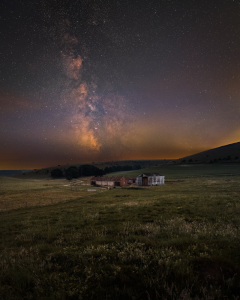 Taking the top spot as overall competition winner was ‘Ancient Light’, by Michael Steven Harris. The shot shows the expansive Milky Way and all its wonderful detail above an abandoned barn in the Balsdean Valley, near Brighton. Judges agreed it was a photo that encapsulated the true beauty of the dark skies in the South Downs National Park.
The judging panel for this year’s competition included ‘Dark Skies’ Dan Oakley, a Dark Skies expert and astrophotographer, Vicki Wells, a Member of the National Park Authority who worked on the BBC’s Sky At Night programme and Elinor Newman, who organises the festival and has a specialism in astrophysics.
About the winning photograph, Dan said: “I think this is an incredible and realistic photo of what the South Downs Dark Skies experience is. It’s beautifully framed.”
Vicki added: “For me, this image shows the stunning dark skies with the working South Downs landscape and its heritage, which is many thousands of years old. We had the first farmers 6,000 years ago so it has a lovely story behind it.”
Michael, who lives in Brighton and wins £250, said: “The abandoned barn is located to the north of Saltdean and east of Woodingdean in Balsdean Valley on the site of what was once a hamlet.
“The site has had a long history with roman occupation, as a medieval hamlet, use as accommodation during the Second World War and for farming. All of which have long since come and gone in the time it has taken for the light from the Milky Way above to reach us, which is approximately 26,000 years!”
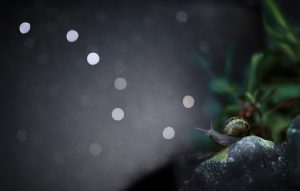 Winning the ‘Life at Night’ category was Richard Murray’s shot, ‘Snail Trail to the Stars’, capturing a snail beneath The Plough asterism.
Elinor said: “This really does encapsulate life at night, with the snail, flora and lichen. The image has incredible detail, captures a moment and takes me to another place. A very inspiring image.”
Richard, from Waterlooville, wins £100 for his amazing photograph.
Richard said: “The South Downs is a magical place to photograph the stars due to its impressive dark skies. Whilst out photographing late one night, I noticed a snail slowly making its way across the stone wall beside where I was standing. As my other camera captured long exposures of the Milky Way, I thought it would be interesting to try to photograph with my other camera this little fellow exploring its surroundings beneath the night sky.
“I placed my camera low below my subject and angled it upwards so that the Plough asterism (part of the larger constellation Ursa Major) sat perfectly above my slimy companion. Using my phone screen, I gently lit the snail as I took its portrait. The macro focus on my subject caused the stars to soften and bloom in the background, allowing this well known asterism to stand out clearly in the background.
“The shot took a lot of patience and a surprising amount of suspense, waiting for the exact moment when my tiny, mucus-powered model lifted both antennae toward the cosmos above. Eventually, the stars, the snail, and the timing all lined up and I got the shot I’d been hoping for.”
Taking the runner-up spot in the category was ‘Four Horses of the Apocalypse’, by Ian Brierley, who managed to capture a golden moment at Cissbury Ring with four horses in silhouette by a full moon.
Ian, from Lindfield, wins £50. Ian said: “I always enjoy researching opportunities to photograph the full moon rising aligned with the many beautiful features of the South Downs National Park, in this instance the lone tree at Cissbury Ring.
“Unexpectedly, four horses appeared forming a defensive circle right on the horizon line so I was able to capture this magical shot with my telephoto lens as the moon rose over a mile away. We are so fortunate to have such amazing dark skies to enable these opportunities on our doorstep.”
The South Downs Dark Skyscapes category was hotly contested with many breathtaking shots of the landscape.
Winning the category was ‘A Window to our Galaxy’ by Lorcan Taylor-Hood, who managed to capture The Milky Way filling up the window and stretching up and over an old ruin near Eastbourne.
Vicki said: “This photo is so interesting and you can see the landscape through the window of the ruin. The image has a real honesty about it about what you can see with the naked eye on a clear night, so it’s a very accomplished photograph.”
Lorcan, from Eastbourne, wins £100. He said: “Through the broken walls of what was once built, ancient light fills the window and the sky above. Even in ruin, there’s still wonder overhead.
“Access to dark skies is a fundamental requirement for astrophotography, and the South Downs offer an excellent environment to observe the night skies.”
Meanwhile, the runner-up spot went to Carl Gough for his photograph ‘Eclipsed’, stunningly depicting a partial lunar eclipse next to Arundel Castle.
Carl, from Littlehampton, wins £50. He said: “This image was taken looking towards Arundel Castle with a partially eclipsed moon setting behind it. I wanted to capture a moment where a rare astronomical event aligns with a historic landmark, highlighting how planning, patience and location all come together in astrophotography. The dark skies of the South Downs are incredibly valuable — they’re among the few remaining areas in the south east where light pollution is low enough to experience and photograph events like this properly.”
Taking the top spot in the meteoric mobile phone category was Mandy Turner’s ‘Moon Halo’, which is caused by the refraction of moonlight from ice crystals in the upper atmosphere, creating a ring effect.
Dan said: “The composition of this image is lovely and it shows the detail of the ice crystals which is amazing on a mobile phone. It looks like the dark sky staring back at you.”
Mandy takes home £100 for her image. Mandy, from Seaford, said: “I was brought up in London and didn’t see much with all the light pollution. It’s a joy to me to now live in Seaford and enjoy the open skies across the South Downs. I have plenty of opportunities now to photograph the night sky. This image is a moon halo which appears when ice crystals form in the stratosphere, which normally is followed in the next day or two with rain or snow.”
This year the National Park introduced a ‘South Downs to Deep Space’ category for the first time and was inundated with some spellbinding shots taken on telescopes from across the National Park.
Winning the category was Jellyfish Nebula, by Nigel Stanbury, showing the remains of a supernova located 5,000 light years away (pictured top).
Dan said: “It looks like a jellyfish, but it’s not – it’s the remains of an exploding star. It looks straight out of Star Trek!”
Elinor added: “This category is about what is possible to see in deep space from the South Downs National Park. We’re all made of stardust and this image just underlines how many stories are out there in deep space. It’s incredible that you can see this on a telescope from the South Downs.”
Nigel, from Haslemere, wins £100. He said: “This photo was taken using a 150 mm diameter telescope from my back garden in a semi-rural location in the north of the South Downs National Park.
“The image is of the so called Jellyish Nebula located in the constellation of Gemini, the Twins. It is the remains of a star larger than our Sun, that exploded as a supernova many thousands of years ago, blowing off a cloud of gas that has been expanding ever since and glows as it collides with surrounding gas and dust. The image was taken over three nights, and needed 22 hours of exposure to bring out the colours and show the finer details of the faint structure. It has taken light 5,000 years to reach us so the image shows the object as it appeared 5,000 years ago!”
Taking the runner-up spot was ‘Winter’s View Orion’ by Tom Elphick.
Tom, from Brighton, wins £50. He said: “For years, I’ve been chasing the light of distant stars, and living on the doorstep of the South Downs dark skies has fueled my love for astrophotography. There is nothing quite like the winter sky when Orion is at its peak. It’s a target that never fails to reveal something new. This particular shot was captured under the deep, ink-black skies of Ditchling Beacon, an ideal location to frame this view.”
The judges highly commended a number of images:
- A Galaxy Far Far Away by Ivana Peranic
- Aurora Above Seven Sisters by Maxine Monaghan
- Belle Tout Lunar Eclipse by Lee Rouse
- Flemings Triangular Wisp by Stephen Martin
- Heart Nebula by Kayal Bodle
- Milky Way over Cuckmere by Daniel Richards
- Moonlit Silver Studded Blue by Anthony Whitbourn
- Shared Sky by Maxine Monaghan
- St Hubert’s Milky Way by Nathan Hill
- Stargazer by Jennie Fellows
- Tail of a Comet by Ivana Peranic
- The Living Night by Tom Elphick
- Trees of Life by Michael Steven Harris
All the winning and highly commended images will be displayed during the Dark Skies Festival, including a touring exhibition at the stargazing events at Seven Sisters, Alice Holt, Queen Elizabeth Country Park and Amberley Museum. Following the festival a range of winning and shortlisted images will be put forward for the People’s Choice vote, with the victor winning £100.
To see the full programme for the Dark Skies Festival visit southdowns.gov.uk/dark-skies-hub/dark-skies-festival.