Gourmet Vegetables

I love April, it’s such a super month in the garden and there are so many beautiful vegetables that you can sow now.

Did you know that it’s just as easy to grow a purple coloured carrot, as it is to grow an orange one? Carrots come in an array of colours – white, yellow, red, purple and many shades in between. Each variety has a slightly different taste and texture. I think they are all delicious and they look fantastic mixed together on the plate. Conveniently, many seed companies sell ‘Rainbow Mix’ packets of carrot seed. Carrots are very easy to grow, but you do need to take steps to avoid their nemesis, the carrot fly. By covering your carrot seedlings with Enviromesh, you will prevent the carrot fly from laying its eggs near your carrots.

Globe artichokes are glorious to grow! Yes, they take up quite a bit of room, but nothing beats freshly harvested artichokes cooked until tender. ‘Gros Vert de Laon’ is a great tasting variety, as is ‘Imperial Star’, which produces a great crop of large heads even in its first year. Don’t forget that you can eat the inner part of the stem of the artichoke as well as the beautiful globes.

Mangetout peas are super plants to grow. I enjoy growing varieties such as ‘Shiraz’ with its attractive purple pods, and the pretty, yellow-podded ‘Golden Sweet’, which is sweet and tender and probably my favourite. Both of these varieties produce easy to spot pods – a real bonus when you’re harvesting, and attractively coloured flowers.

For pea shoots, my preferred variety would be ‘Oregon Sugar Pod’ which is marketed as a mangetout pea, but in all honesty any variety of pea would be suitable. Just cut the tops off your plants when they reach about 12cm (5 inches) and wait for them to re-grow. Pea shoots can easily be grown in a window box or container.

Kohlrabi is an absolutely delicious vegetable, often hard to find in the shops, but it’s easy to grow in the garden. For some years now I have been growing a variety called ‘Gigant’, available from Real Seeds, which is an amazing variety. It’s delicious harvested at a much larger size than traditional kohlrabi varieties, which you don’t want to allow to grow much larger than a golf ball, or they become rather tough and woody. I’ve regularly eaten Galia melon sized ‘Gigant’ and have found it to be delicious and very tender. Later sowings of ‘Gigant’ are great for storing over winter.

Almost instant gratification can be found if you sow coloured radishes, which will be ready to eat just a few weeks after sowing. Radish seed can be sown direct into the soil or in containers. If you’re sowing a row of parsnip seeds, sow some radish seeds in the same row – parsnips take a long time to germinate, whereas your radish seed will have germinated, been harvested and eaten before the parsnip requires the space. Do purchase new parsnip seed each year, this is one variety of vegetable seed that doesn’t remain viable for long and cannot be stored – why not share a packet with your friends or neighbours?

There are many other gourmet vegetables that you can sow now: rapini, salsola soda, kale, salsify, scorzonera, amaranth, shallots, quinoa and pak choi. That should keep you all busy!

For more tips, advice and ideas of other lovely jobs that you could do in your garden or at your allotment this month, more ideas of seeds that can be sown now, and much more besides, please visit my website www.pumpkinbeth.com.


Dennis Brothers – the second chapter

Britain’s oldest vehicle manufacturer was established in Guildford. In the second in a series, Andy Goundry continues the story.

The end of the Great War brought a sudden and dramatic change to the fortunes of the Dennis company. From working almost flat-out producing trucks for the War Department, the order book vanished almost overnight as the vast fleet of vehicles which Dennis had toiled so hard to produce began to find their way back to Britain, to be sold off for civilian use, thereby reducing dramatically the opportunities for new vehicle sales.

This left Dennis with an almost insurmountable problem: they had one of the biggest truck-making factories in Europe, capable of building around 2,500 trucks per year, and a very limited market. Lesser companies might have thrown in the towel there and then, however the Dennis brothers picked themselves up and set out to develop both new markets and new models.

The latter was an inspired move, for if WWI had done nothing else, it had firmly established the superiority of trucks rather than horses to move goods. Whilst the market was saturated with large numbers of ex-military trucks, they were limited to a 3 tonne payload. Dennis realised that higher capacity models would generate sales, and so introduced both 4 and 5 tonne versions of the original army truck. These were successful in recovering some of the lost sales; then, as now, the concept of one man, or truck, being able to do more than his competitors, was attractive to customers.

Raymond Dennis also set out on a marathon 60,000 mile world tour to promote Dennis products, highlighting the reliability of the military vehicles, to say nothing of the fire engines whose performance was becoming legendary. Indeed, in 1917 a Dennis fire engine had pumped water continuously for 17 days to help combat a huge fire in Salonika (now Thessaloniki) in Greece.

In seeking new markets, Dennis astutely investigated opportunities to offer innovative products into markets where the Dennis brand was already well understood and respected. He also targeted markets which could make use of some of their existing technology, thus avoiding too much of a leap into the dark.

Two interesting new ventures sought to strengthen the Dennis relationship with local authorities, quickly becoming successful businesses in their own right. Firstly, drawing on their experience with fire pumps, they launched an innovative vacuum cesspool emptier which was quickly taken up by their target local authority market. This laid the foundations for the municipal vehicle market for which Dennis subsequently became a by-word.

The other new venture was into the manufacture of motor mowers, and specifically large machines which enabled the local authorities to keep their many hectares of parkland in trim. Again, Dennis were quick to promote the efficiency benefits of their product, proudly proclaiming that one man with a Dennis mower could cut in a day as much as two men and a horse could cut in two days. Dennis mowers went on to carve out a successful business for over 50 years, indeed they are still manufactured, although no longer part of the original Dennis empire, having been sold off in 1976.

This superbly restored Dennis Ace fuel tanker is locally owned by Joe Devanny, and can regularly be seen at the Goodwood Revival. Photo: J Devanny

This superbly restored Dennis Ace fuel tanker is locally owned by Joe Devanny, and can regularly be seen at the Goodwood Revival. Photo: J Devanny

The 3 tonne model which played a major part in the Great War but later returned to the UK in large numbers to flood the market. The fine example shown here was restored over a 10-year period by Tim & Steve Gosling. Photo: M Sutcliffe

The 3 tonne model which played a major part in the Great War but later returned to the UK in large numbers to flood the market. The fine example shown here was restored over a 10-year period by Tim & Steve Gosling. Photo: M Sutcliffe

Despite these brave efforts to regenerate the business, orders for Dennis trucks remained in the doldrums until the mid-1920’s, when the company launched a successful new 30cwt (1.5 tonne) payload truck, set apart from its competitors by the use of robust truck components compared to the lighter and shorter-lived car components used by others. This approach was, interestingly, mirrored by the company almost sixty years later when the Dennis Dart midibus took the bus market by storm.

The latter half of the 1920’s saw the Dennis market for buses and coaches grow significantly, with new models appearing regularly, championing the latest technology. The first bus to be equipped with pneumatic tyres, for example, was a Dennis, as was the first bus fitted with four-wheel brakes. Development of specific models aimed at carrying passengers rather than goods also meant that floor levels were lowered, meaning fewer steps for the passengers to climb.

1927 saw the introduction of another first for Dennis – their purpose designed double-decker. Although double deckers had been around for some time before this, in both horse-drawn and later motorised form, they were invariably based on a goods vehicle chassis. This meant they were comparatively tall, making a solid roof impractical. The Dennis H Type of 1927, in contrast, had a low frame, enabling a solid roof to be fitted, setting the scene for the widespread adoption of double deckers in years to come.

As the 1930’s dawned, a relentless introduction of new and enhanced models continued apace, all promoting the traditional Dennis virtues of quality, performance, and reliability. These benefits came at a price, making Dennis products amongst the more expensive in the market. By this time, however, the world was sliding headlong into the Great Depression, and in those times of austerity, the expensive Dennis products, however good, were finding fewer customers.

Once again, Dennis were forced to rethink their product strategy, and rapidly introduced the Lancet, a low-cost single deck bus, which sold for £595 against their previous single decker, which was massively more, at £1,095. Unsurprisingly, the Lancet became a great success, doing much to see the Dennis business through the gloomy days of the Depression, particularly with the truck-making arm of the business struggling due to the economy. Indeed, throughout the history of Dennis, the bus business proved to be surprisingly resistant to economic depression, and this was not the only occasion where it kept the company afloat.

Other noteworthy Dennis models of the 1930s included the Dart bus, of which one survives today in the hands of the company, and which can often be seen at rallies.

On the truck side, Dennis produced a rather unusual-looking, but very successful range called the Ace. Key to the Ace was that the front axle was set well back, giving excellent manoeuvrability, but meaning that the engine and radiator were positioned well forward like a snout. Small wonder that the Ace soon became unofficially named the ‘Flying Pig’.

In 1934, Dennis acquired land around the Woodbridge factory on which to build homes for their increasing number of workers. The resulting estate, Dennisville, has most of the roads named after senior Dennis people, notably Raymond Crescent & St John’s Road.

Overall, Dennis had coped well since WWI, rising well to the challenges of the lack of new vehicle orders, the years of recession and fending off the growing number of competitors such as Leyland and Bedford. Sadly, however, in May 1938 Sir Raymond Dennis passed away at the early age of 59, followed only three months later by his brother John, precipitating the company into major changes at the top. At the same time the gathering storm clouds of WWII were about to force Dennis into yet more major upheaval.

About the author: Andy Goundry spent his working career in vehicle design and development, with almost 20 years in senior engineering and management roles at Dennis. Since retirement he has continued a close involvement with vehicles, writing for specialist magazines and websites, as well as producing his own motoring website www.autonews.uk.com. © Andy Goundry December 2014


Weekend Walk: Tilford to Elstead (9.5 miles)

This walk has an almost six mile initial section which has in it a strenuous climb but it will reward you with some spectacular views.  The second section is much shorter and more or less flat.  The description was submitted by Guildford Rambling Club who will be walking it in May (see guildfordramblingclub.org.uk). You are welcome to walk it with them.

1. Cross the bridge and, on the other side, take the footpath to the left. After a level start, climb a little to a T-junction with a lane. Turn left and the lane quickly ends and continues as a track. After 250 yards fork right on a red arrow permissive path. Follow this through, ignoring lefts and rights, to a road. Go straight across to continue forward along a track for about 1/3 mile to a T-junction. Here take the red arrow option left. Now walk ¼ mile to a busy road. Turn right and walk uphill along the road for 300 yards to find a footpath left, at the side of the entrance to Keepers Cottage Stud. Follow this as it rises to pass Yew Tree Cottage and then the two Waverley Cottages and reaches another road.

2. Go straight across to join a bridleway and follow it left and then left again. Walk through to Crooksbury Hill car park. Now take the leftmost option from the back of the car park to start the long and increasingly steep climb up onto Crooksbury Hill. Stop at the viewpoint. It will have been worth the effort! Afterwards, with your back to the view, head right, off of the other side of the top and steeply down. Trend a little left to reach a point where a path strikes off right and runs alongside a fence. Follow this through to reach a road directly opposite the start of footpath along a wide track. Follow this for about 1/3 mile to a T-junction with a wide track. Turn right and walk out into the Crooksbury Conservation Area. Now walk for about 3/4 mile along the wide track, at one point passing out of the conservation area then passing a few houses and eventually reaching a road.

3. The Donkey PH is on the other side of this road but you will not reach it because, some 30 yards before the road, at a 3-way signpost, is a footpath left. Take this and climb up to emerge at the end of a drive. Continue forward to exit through the gate of Three Barrows (adorned with eagles) onto Seale Road. Go straight over and along the path opposite to reach another road. Again go straight over, heading towards Broomfield Cottage but then turning left onto a footpath in a field. Cross the field half-right to a gate into a wood. Walk through the wood to reach the road that runs through the village of Gatwick. Turn right, cross a stream and continue for about ¼ mile, passing the houses and going over a rise and then turning right into Attleford Lane. Some 350 yards along here, by the side of a house, take a footpath right. Pass a house and farm buildings and the track becomes a narrow path. Traverse a footbridge eventually arrive at road. Head right. Cross a bridge over a river and, 100 yards further on, turn right on a track. Emerge in a long field. Continue to exit it at the far end. The path brings you to the dead-end of Ham Lane. Follow this, to the right, for some 1/3 mile, to reach its end at the main road through Elstead. Turn right and walk along to the Woolpack PH, a café, shops and a little green where you could picnic.

4. After lunch, take the Churt/Thursley Road and walk to the church. Here, turn right to walk along for about 1/2 mile to the end of Westbrook Hill. At the end of the road, take the track right, into an MOD area. Follow this wide track for 1/4 mile to reach a 5-way junction. Of the two blue arrow options ahead, take the rightmost. Continue on across heathland, passing a house on the right-hand side, still following blue arrows and ignoring lefts and rights. The track swings close to the river (which is down to the right-hand side). Reach a barrier and, beyond it the angling lake at Stockbridge. Continue forward to the road by the Stockbridge parking area and turn right to walk along inside the hedge to Tilford and the start.

DISTANCE: 9.5 miles

OS MAPS: Explorer 145 Guildford & Farnham, Godalming & Farnborough

STARTING POINT: The parking area by the bridge in Tilford, between the cricket pitch and the river.

REFRESHMENTS:
The Woolpack PH, The Green, Elstead GU8 6HD
T: 01252 703106
www.woolpackelstead.co.uk

The Barley Mow, Tilford GU10 2BU
T: 01252 792205
www.thebarleymowtilford.com

Map © Crown copyright 2016 Ordnance Survey. Media 008/16


Woolbeding Gardens – a modern masterpiece

Quietly tucked away in the valley of the River Rother lies one of the most beautiful gardens in Sussex.  Woolbeding is a modern masterpiece featuring colourful borders, a landscape garden and a collection of follies. 

Woolbeding Gardens is a world away from many of the grand historic gardens the National Trust cares for, and a visit here is more akin to a tour of a private garden. Special viewing arrangements mean that visitors book in advance, and are driven to the gardens twice a week via regularly running shuttle buses. This allows the gardens to retain a feeling of intimacy and tranquillity, and gives the visitors more of a ‘personal’ experience.

Woolbeding is also unusual in that it is constantly changing. Experimentation with planting has given this garden a reputation as a 21st-century masterpiece that always has something new to reveal. A garden of two halves, the formal gardens are broken up into ‘rooms’, each with a different colour theme, from vibrant reds to pastel pinks, using a combination of rare and not-so-rare flowering plants. The quality of the planting means this is both a plantsman’s garden as well as a garden for anyone who enjoys gorgeous horticultural shape and colour.
When you arrive, you will be welcomed into the Entrance Garden which was formally the old farmyard but now has a Mediterranean feel, with formal water pools surrounded by African lilies and olive trees.

At the heart of the garden are the West Borders. A palette of blue, white and pale yellow, roses, tulips and forget-me-nots carefully line the avenue, perfectly framing the view beyond the gates into the countryside. The walls are full of climbing roses and the borders are bursting with bloom in full season.

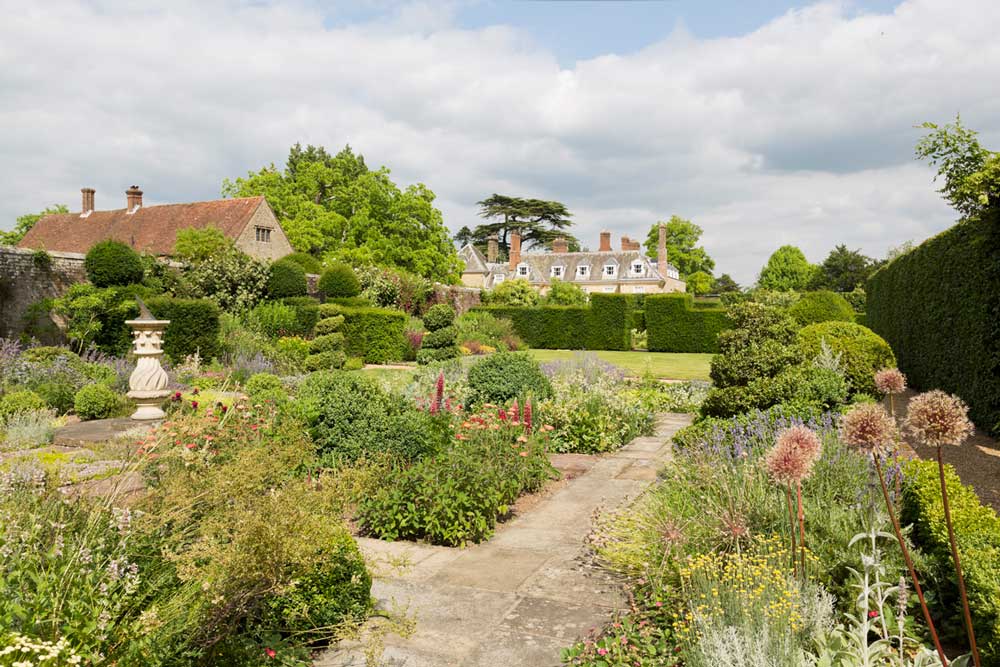
Wander through the well garden and into the fountain garden where you’ll find one of Woolbeding’s hidden gems, and a mass of colour from rich pinks and splashes of blue to sunset oranges. The herb garden features a sundial at the centre and spiralling topiary balls alongside English apples climbing up the walls. In season, the beds are filled with lavender, thyme and plenty of offerings for the kitchen.

Beyond the garden, a gentle stroll over open pasture land provides idyllic views of the River Rother, and leads to all sorts of picturesque delights such as the quirky Tulip Folly, which is surrounded by glorious views, and space in which to picnic and relax.

Take the steps down from the Tulip Folly and walk along by the River Rother. Here you’ll find meadows of buttercups, daises and foxgloves growing wildly into the sweeping landscape. Walk slowly along the hornbeam tunnel and admire the trees, twisting at every turn.

Wander through the kissing gate and enjoy picturesque views over the river towards the long walk. Navigate your way along rustic woody paths to reveal a gothic summerhouse where you’ll find the River God grotto, waterfall, Chinese bridges, secret sculptures and hidden views.

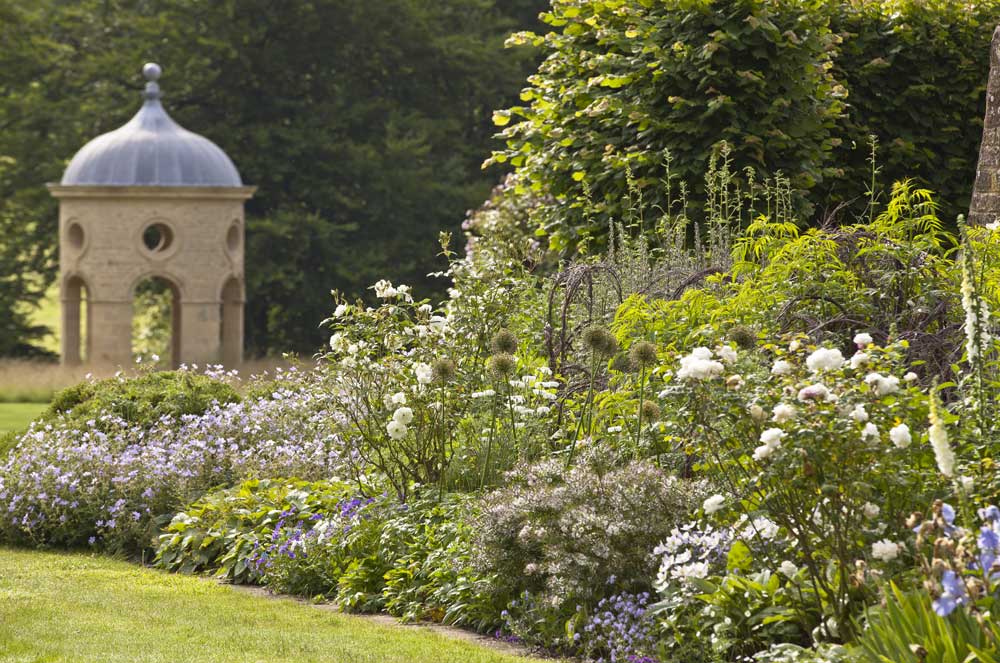
Woolbeding-Gardens---herbaceous-borders-with-rotunda-beyond,-credit-National-Trust-Images,-Chris-Lacey

The 26-acre garden was the creation of Mr Simon Sainsbury and Stewart Grimshaw. With the help of notable garden designers Lanning Roper in the 1980s and the Bannermans in the late 1990s, Woolbeding has developed into the stunning contemporary creation you see today. Woolbeding is a private garden so visitors won’t find any plant labels. Instead, they’ll find friendly and knowledgeable gardeners who are always happy to answer questions and offer advice.

Woolbeding Gardens has sumptuous displays throughout the year. In spring, enjoy bright splashes of bulb colour, as well as azaleas, hellebores and early flowering perennials. In summer, the stars of the show are the summer borders, fragrant roses, the potager, vegetable garden, and herb garden. In autumn, it’s the turn of the trees and shrubs in the Long Walk, as well as late flowering perennials.

Woolbeding Gardens has an ‘orchid greenhouse’ in the garden, containing the incredible 40 year old collection of orchids lovingly amassed by Woolbeding’s previous tenants, benefactors and creators of the garden – Simon Sainsbury and Stewart Grimshaw. Surrounded by wildflowers and seating, the greenhouse contains over 120 varieties of orchid. Visitors can enter this exotic floral sanctuary during normal opening hours.

Enjoy views of Woolbeding’s new folly, overlooking the garden from the parkland. Constructed of local Fittleworth stone and built in memory of Simon Sainsbury, it was designed by Richard Lincoln to complement the Tulip Temple which stands close to the main lawn.

Woolbeding-Garden,-view-of-garden-topiary-and-house,-credit-National-Trust

A new 25m x 4m border has been created in the Greenhouse Garden, which will look glorious in summer. The border was designed in-house by the garden team and has been planted using a wide range of large leaf plants, as well as bright oranges, reds and yellows to complement the rest of the existing greenhouse garden. There is a ‘tropical’ bed featuring architectural plants with bold foliage, ferns and hostas, as well as a more herbaceous bed, and a gravel bed containing Aloes and Agaves.

Woolbeding Gardens’ new orchard produces a riot of colour from April until June from 5,000 mixed bulbs planted in long grass such as narcissus, casmassia, eremurus and alliums. Mature fruit trees give instant impact – there are 18 apple trees of three different varieties and five trained conference pear trees, filling the orchard with fruit blossom in April and May. A mill stone table lies in the centre of the orchard for people to sit around and picnic, or simply indulge in the sights and sounds of the orchard.

This enchanting garden is a haven for horticultural enthusiasts, who can also pick up  expert gardening tips at Woolbeding’s series of technical workshops. The enticing-sounding topics include an introduction to the world of orchids, how to create gorgeous summer containers, and propagation for beginners. All workshops cost just £18 including admission to the garden, and refreshments on arrival.

If you want to sit down and indulge in the beauty of the garden around you, then the pretty 19th-century style French themed Orchard Café is the perfect place in which to do this. Providing a range of sandwiches, homemade cakes and barista coffee, its wood-burning stove gives it a cosy feel on chillier days, whilst cool drinks and ice creams are the perfect treat for warm summer days. You’ll also find a pretty selection of gifts on offer, from gardening books to plants.

These wonderful gardens can now accommodate coach groups of up to 55 people at a time, and you can book an introductory welcome talk for your group, from one of the senior members of the garden team. Whilst the cosy Orchard Café is on hand for delicious treats, and picnics are welcome in the garden, groups can also pre-book a luxurious afternoon cream tea. Bookings can be made on 0844 249 1895. Please check out the voucher on our website.

Woolbeding Gardens re-opens on 7th April 2016 and as they are without a visitor car park, there is a complimentary park and ride scheme on hand to take you from nearby Midhurst and drop you directly outside Woolbeding Gardens. Open on Thursdays and Fridays only. For more information or to pre-book your visit, call 0844 249 1895 or visit the website at www.nationaltrust.org.uk/woolbeding-gardens.


Dennis Brothers – the first chapter

Britain’s oldest vehicle manufacturer company was established in Guildford. In the first in a series, Andy Goundry tells the story.

Most folk enjoying a quiet drink in the Wetherspoons pub at the bottom of North Street in Guildford will be unaware that they are relaxing on the site of Britain’s oldest-established vehicle manufacturer. Indeed one of the oldest in the world, with a history which can be traced back to 1895 and the closing years of the Victorian era.

During Queen Victoria’s reign, the industrial revolution had seen both the birth and rapid development of the railway system, offering comparatively fast ways to transport both goods and people over relatively long distances. As the 19th century ended however, that railway supremacy was about to be challenged, and subsequently beaten, by a new form of road transport – that powered by internal combustion engines.

Few of the pioneers of this second industrial revolution can have imagined how their early inventions would develop. Certainly one John Dennis would not have done so when he left his native Devon in 1894 to join Filmer & Mason, a firm of ironmongers in Guildford High Street. As a country boy, John’s interests lay in farm machinery, and soon after arriving in Guildford in 1895 he built a bicycle, using parts bought through his employer. This first machine was soon sold profitably, leading to the manufacture and sale of further cycles, and, after a period working for a cycle manufacturer in London, John was able to set up his own business in 1895, selling his Speed King and Speed Queen cycles from The Universal Athletic Stores at the bottom of Guildford’s High Street. John’s brother, Raymond, then only 17, soon moved up from Devon to join John in his growing business.

In a far-sighted move, John and Raymond built, in 1897, a motorised tricycle fitted with a single-cylinder De Dion engine. Although inevitably primitive, this machine must have been reasonably effective, for as company folklore recalls, John became one of the first, if not the first person, to fall foul of motoring law by being prosecuted for ‘driving furiously up Guildford High Street at the speed of 16 mph’. A not inconsiderable fine of 20 shillings was repaid many times over as the Dennis brothers used this incident in their advertisements as proof of the machines speed. Then – as now – speed sells!

Motorised tricycles soon gave way to motorised quadricycles, which although far from substantial vehicles, set the scene for a move into building motor cars in 1901. This was facilitated by a move from the outgrown High Street premises to an old army barracks in North Street.

In 1901 motor cars were still a rarity, with probably no more than 500 in Britain, however the Dennis brothers continued to invest in their belief in the future of motoring, they expanded further with a purpose-built office and factory – the Rodboro Buildings on Onslow Street, now the home of JD Wetherspoons amongst others. Indeed, so successful were sales of the Dennis Brothers products that the firm moved into part of the new factory even before the rest was completed.

Interestingly, final assembly of cars was carried out on the third floor, the lower floors being given over to stores, offices, showrooms and component manufacturing. A large lift was therefore required to carry the finished cars down to ground level.

As the sales of motor cars increased, and as more manufacturers jumped on the bandwagon, the Dennis brothers looked for diversification opportunities. They quickly realised that the principles developed for moving people via motor cars could be adapted to move goods, thereby providing significant benefits to businesses large and small who had hitherto been reliant on horse-drawn transport.

In 1904, Dennis built their first commercial vehicle, a 15 cwt van for Harrods department store. Shortly afterwards, their first bus followed, which plied between Kingston-upon-Thames and Richmond.

Rapid success in sales of this broadened product range meant that the capacity of the Rodboro Buildings factory was again soon exceeded. A new 10 acre site was purchased at Woodbridge Hill, then a greenfield site on the edge of Guildford. Never ones to spend money unnecessarily, one of the first buildings on the site was reputedly a disused Mission Hall from Brixton which was dismantled, transported 30 miles, and re-erected to become No. 1 shop.

A further broadening of the Dennis range in 1908 proved to be significant, when a fire engine was produced for the City of Bradford Brigade. Traditionally, fire engines had been horse drawn, and used steam-powered pumps, with inevitably slow response times. In contrast, Dennis’s Bradford appliance could be on scene quickly and pumping immediately, thanks to its White & Poppe petrol engine. The success of this revolutionary appliance initially led to London and then other fire brigades throughout Britain, and indeed throughout the world. The name Dennis soon became synonymous with Fire in the public’s eye.

Sales success in fire engines was matched by thriving orders for buses and other heavier vehicles, at the expense of the original passenger cars. Indeed, in 1909 the company issued a statement to confirm that it was still building ‘passenger cars’. In truth however, the manufacture of Dennis cars was a relatively short-lived era, with comparatively few ever having been built. Fittingly two of the very few remaining cars belong to John Dennis, grandson of one of those original Dennis brothers, and can be regularly seen participating in the London to Brighton Veteran Car Run.

By 1910, Dennis’s claimed proudly, and justifiably, that their fire engines operated all over the world, from Auckland to Zanzibar, whilst over 1,000 Dennis lorries and vans were at work moving goods around the country.

Perhaps one of the company’s greatest strengths in these pre-Great-War years of rapid growth came from its ability and readiness to produce vehicles for specific uses, alongside their more standard ranges. This flexibility was made possible by the Woodbridge Hill factory making complete vehicles rather than just bodies or chassis.

By 1910 the factory was producing 1,000 vehicles annually. The factory was extended several times, covering over 260,000 square feet by 1916 – massive by any standards.

Even before then, war was in the air, and Dennis, which became a public company in 1913, took the decision to cease passenger car production in favour of concentrating on commercial vehicles. In part, this was in response to the Government’s recognition that the coming war would need far more in the way of reliable mechanised transportation than was readily available. Thus the Government devised the ‘subvention scheme’, whereby the owner of a lorry approved by the War Department, who made that vehicle available for use for the war effort, would be rewarded with a payment of £110. The vehicle types approved for this subsidy were subjected to rigorous testing by the War Department, thus owners who participated in the scheme not only received the cash subsidy but invested in the vehicle in the knowledge that it had successfully passed these tests.

Dennis was in the forefront of manufacturers submitting vehicles for these tests. Their vehicles successfully completed the tests without too much change. The foresight of both the Government and Dennis paid off as over 7,000 of these reliable vehicles were built over the war years, seeing honourable and trusty service in all theatres of war.

The Woodbridge Hill factory toiled day and night during the war to produce these vehicles, leading to the directors receiving a letter of encouragement from Lord Kitchener.

Ironically, at the end of the war this effort resulted in a vast fleet of surplus lorries no longer needed by the military. These found their way back to the UK and at a stroke destroyed the market for new lorries and indeed buses, thereby precipitating the Dennis business into its first real challenge in a new and uncertain future.